
HVAC questions& honest answers.
Browse our answers to common questions about system troubleshooting, maintenance schedules, and energy efficiency. We believe a well-informed homeowner is a comfortable one.
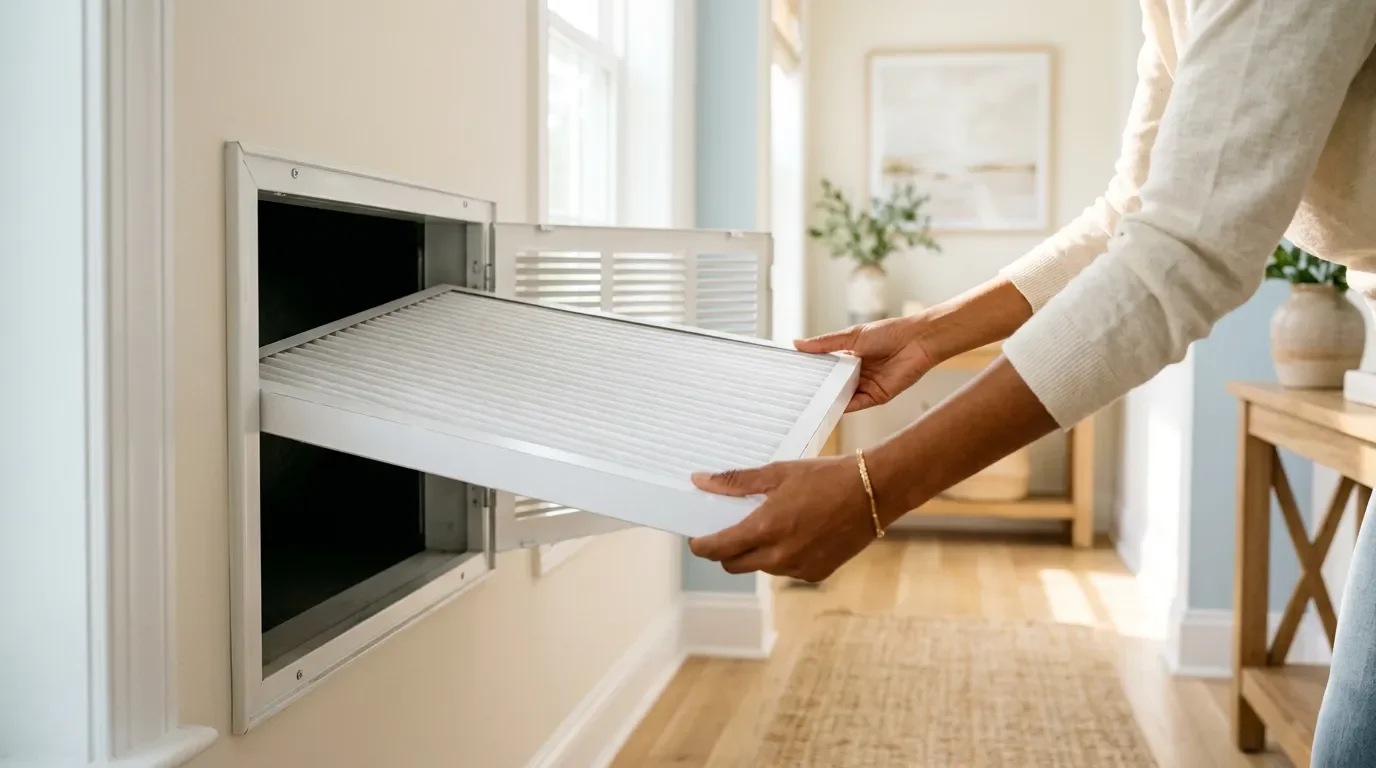 A clean filter changes everything
The questions we hear every week
For standard 1-inch filters, we recommend changing them every 30–90 days. Homes with pets or allergy sufferers need more frequent changes. Thicker media filters can last 6–12 months.
This typically results from a tripped breaker, a frozen evaporator coil, or low refrigerant levels. Check the breaker and filter first; if the problem persists, it’s time for a professional diagnosis.
NATE (North American Technician Excellence) is the gold standard for HVAC technical mastery. Certified technicians diagnose correctly the first time — which means fewer repeat visits and repairs that hold.
It depends on your home’s thermal load and energy goals. Gas furnaces deliver hotter supply air and cheap heat when gas prices are low; modern cold-climate heat pumps win on efficiency and qualify for significant tax credits. Read our full comparison.
An evaporator coil freezes when its temperature drops below 32 degrees Fahrenheit, causing moisture in the air to turn to ice on the coils. The usual culprits are restricted airflow (dirty filter or blower) or low refrigerant charge.
A dual-fuel system pairs an electric heat pump with a gas furnace. The heat pump handles mild weather efficiently; when outdoor temperatures drop below the balance point, the system automatically switches to gas heat — each fuel doing what it does best.
Static pressure measures the resistance to airflow within your duct system. Too high, and your blower strains, rooms starve for air, and equipment life shortens — it’s the blood pressure reading of your HVAC system.
Twice a year — once before cooling season and once before heating season — because a heat pump works year-round. Our Energy Saver Agreement covers both visits.
A hard start kit contains a starting capacitor and a potential relay. It gives an aging compressor the extra torque it needs to start smoothly, reducing wear and lowering start-up amp draw.
A potential relay monitors the voltage across the compressor start windings. As the motor comes up to speed, back-EMF rises and the relay drops the start capacitor out of the circuit — precise, automatic, every start.
More homeowner questions
Manual J calculates the heating and cooling load of the house. Manual S uses that load to select equipment that fits the job. Manual D addresses duct design so the equipment can move the right airflow to each room. A replacement should not rely on square footage alone because windows, insulation, sun exposure, duct leakage, and room layout all change the load.
Static pressure shows how hard the blower is working to move air through the filter, coil, ductwork, and registers. High pressure can reduce airflow, raise energy use, freeze AC coils, overheat furnaces, and shorten blower life. It is one of the most useful measurements for separating equipment trouble from duct trouble.
SEER2 measures seasonal cooling efficiency under updated test conditions. EER2 measures cooling efficiency at a specific operating point. HSPF2 measures heat pump heating efficiency across a season. These ratings help compare equipment, but the installed system still needs correct sizing, matched components, and proper airflow.
AFUE stands for Annual Fuel Utilization Efficiency. It estimates how much fuel becomes usable heat over a heating season. An 80% AFUE furnace sends about 80% of fuel energy into the home and loses the rest through exhaust. High-efficiency condensing furnaces capture more heat from flue gases and need proper condensate and venting setup.
HVAC equipment replacement is regulated under Virginia's Uniform Statewide Building Code. Mechanical and electrical permits are typically part of proper replacement work. Commonwealth holds a Virginia Class A contractor license with HVAC and electrical designations, allowing the company to pull residential mechanical and electrical permits directly.
R-454B is a lower-GWP refrigerant used in new air conditioners and heat pumps as the industry moves away from R-410A. It is classified A2L, meaning mildly flammable under specific conditions. New systems include components and safety controls designed for it. Older R-410A systems cannot be converted to R-454B.
The system may be oversized, short cycling, moving too much or too little air, or dealing with high indoor moisture. Northern Virginia summer dew points often reach the 70s, so latent heat removal matters. A correct diagnosis looks at runtime, airflow, coil condition, refrigerant behavior, thermostat fan settings, and the home's load.
Most summer water issues involve condensate. The evaporator coil removes moisture from the air, and that water should drain safely through a pan, trap, and drain line. Clogs, cracked pans, failed condensate pumps, frozen coils, or missing float-switch protection can send water where it does not belong.
Leaky ducts can lose conditioned air before it reaches the room. Return leaks can pull dusty, humid, hot, or cold air from wall cavities, attics, crawl spaces, or basements. Duct leakage can make a properly sized system look weak and can harm indoor air quality. It should be considered before replacing equipment for comfort complaints.
The thermal balance point is the outdoor temperature where a heat pump can no longer carry the whole heating load by itself. The economic balance point is where another fuel, such as gas in a dual-fuel system, becomes less expensive to run. Balance point depends on equipment capacity, home load, and utility costs.
Commonwealth's Energy Saver Agreement includes two visits per year: a spring cooling tune-up and a fall heating inspection. Agreement members receive priority scheduling and a 15% repair discount. The visits also create maintenance documentation, which can matter for warranty records and long-term system planning.
For system replacements, Commonwealth works with lending partners offering fixed-rate financing from 12 to 72 months. The application takes about ten minutes and uses a soft credit check that does not affect your score. Financing should be compared alongside repair cost, efficiency, warranty coverage, and expected time in the home.
More replacement questions
The existing FAQ content notes that a standard replacement typically takes 6 to 10 hours, while complex multi-stage systems or homes requiring significant ductwork modifications may take 2 days. The actual schedule depends on access, permits, equipment type, duct changes, electrical work, and commissioning.
Commissioning proves the installed equipment is operating as designed. The technician checks airflow, refrigerant charge, temperature split or rise, electrical readings, controls, condensate drainage, and safety operation. Without commissioning, a new system may run but still fail to deliver its rated efficiency or comfort.
Matched equipment means the indoor coil, outdoor unit, furnace or air handler, and controls are designed and rated to work together. Efficiency ratings such as SEER2 and HSPF2 depend on tested combinations. Mixing unmatched components can reduce performance and complicate warranty or rebate documentation.
A repair-or-replace mini guide
| Repair May Make Sense | Replacement May Make Sense |
|---|---|
| The system is younger, the failure is isolated, and safety is not in question. | The system is near or past typical service life and needs a major component. |
| The ductwork and airflow are acceptable, so the repaired equipment can operate correctly. | Comfort has never been right because sizing, airflow, or humidity control is wrong. |
| Warranty coverage still applies and the repair restores reliable operation. | Warranty coverage has expired and repeated repairs are stacking up. |
| The homeowner needs a short-term fix before a planned future upgrade. | Financing, warranty, efficiency, and incentives make replacement worth comparing now. |
A few numbers worth knowing
A standard replacement typically takes 6 to 10 hours; complex multi-stage systems or homes requiring significant ductwork modifications may take 2 days. A programmable thermostat can reduce energy usage by 8 to 12 percent when configured correctly — set temperatures back 7 to 10 degrees while away or asleep.
Standard 1-inch pleated filters should be replaced every 30 to 90 days; homes with pets or allergy sufferers need more frequent changes. And if a repair bill is climbing on equipment past its 12–15 year design life, ask us for the written repair-vs-replace comparison before deciding.
HVAC terms worth knowing
- Manual J
- A residential load calculation method used to estimate how much heating and cooling a home needs. It considers room sizes, insulation, windows, orientation, occupancy, and other building details.
- Manual S
- The equipment selection step that follows Manual J. It helps match furnace, heat pump, or air conditioner capacity to the calculated load instead of choosing equipment by habit.
- Manual D
- The duct design method used to size and lay out ductwork. It connects the equipment's required airflow to the rooms that need that air.
- Static pressure
- The resistance to airflow inside the duct system, measured in inches of water column. High static pressure makes the blower work harder and can reduce comfort, efficiency, and equipment life.
- SEER2
- Seasonal Energy Efficiency Ratio 2, the updated cooling-efficiency rating for air conditioners and heat pumps. It uses more realistic test conditions than the older SEER rating.
- HSPF2
- Heating Seasonal Performance Factor 2, the updated heating-efficiency rating for heat pumps. A higher HSPF2 generally indicates better seasonal heating efficiency.
- AFUE
- Annual Fuel Utilization Efficiency, used for furnaces and boilers. It estimates the percentage of fuel energy converted into usable heat over a season.
- MERV
- Minimum Efficiency Reporting Value, the standard rating for how well an air filter captures particles. Higher MERV can improve filtration but may restrict airflow if the system is not designed for it.
- R-454B
- A lower-GWP refrigerant used in new residential cooling and heat pump equipment. It is an A2L refrigerant, so installation procedures and equipment design differ from older R-410A systems.
- Condensate
- Water removed from indoor air as moisture condenses on a cold evaporator coil or from a condensing furnace. It must drain safely to prevent water damage and shutdowns.
Quick troubleshooting boundaries
Some homeowner checks are reasonable. Others should stop at the switch.
- Check the thermostat mode: Confirm heat, cool, or auto is set correctly before assuming the system failed.
- Check the breaker once: A single tripped breaker can be reset, but repeated trips need service.
- Look at the filter: A clogged filter can cause weak airflow, frozen coils, or furnace overheating.
- Look for ice: If refrigerant lines or the indoor coil are frozen, turn cooling off and call for diagnosis.
- Look for water: Water near the indoor unit may mean a clogged condensate drain, frozen coil, or failed pump.
- Do not bypass safeties: Door switches, float switches, rollout switches, and limit switches protect the home and equipment.
- Do not add refrigerant blindly: Low charge means a leak or another measurable issue; refrigerant is not a consumable.
- Do not ignore combustion smells: Persistent burning, gas odor, or carbon monoxide alarms require immediate attention.
The safest answer for an HVAC problem is the one tied to measurements from your system. If you smell electrical burning, see water around equipment, have no heat in freezing weather, or the breaker trips repeatedly, call (703) 436-8028. Standard hours are Mon-Fri: 7:30 AM to 5:00 PM, with Sat-Sun closed except emergency calls.
Still have questions?
Our comfort engineers are standing by to provide expert advice for your specific home layout.