
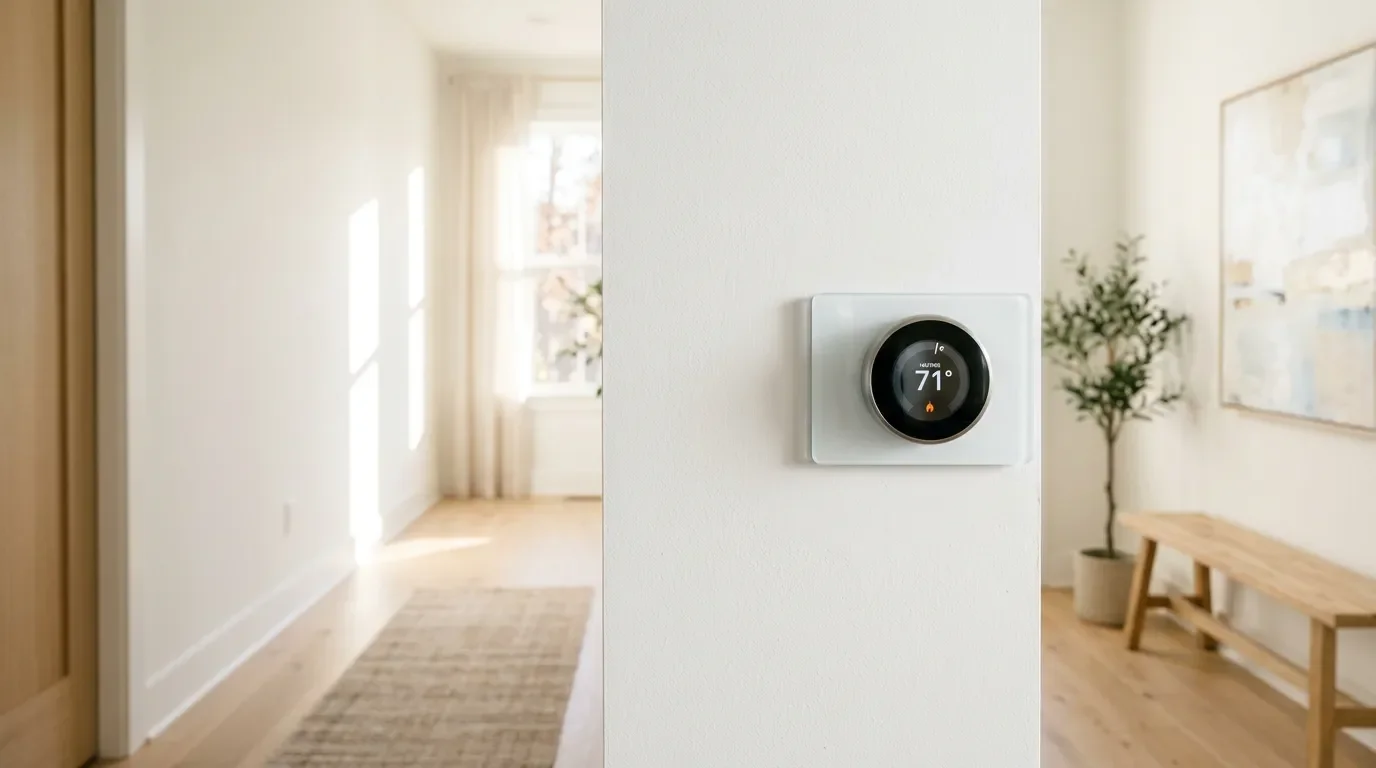
If your upstairs bedrooms run warm while your basement stays cold, the problem usually is not your air conditioner. It is the way a single thermostat tries to control an entire multi-level home. Zoning systems and smart controls are how we fix that imbalance for two and three story homes across Northern Virginia.
Why One Thermostat Can't Cool a Whole House
A traditional system has one thermostat, usually on the main floor, and it makes decisions for the entire house. When that thermostat is satisfied, the system shuts off, regardless of what is happening upstairs or in the finished basement.
In a multi-level home, that single sensor cannot represent every floor. By the time the main level is comfortable, the upstairs may still be several degrees too warm. The equipment is working correctly; it simply does not have enough information.
How Zoning Systems Work
Zoning divides your home into independently controlled areas, each with its own thermostat. Motorized dampers inside the ductwork open and close to direct conditioned air only where it is being called for, all coordinated by a central zone control panel.
When the upstairs zone calls for cooling, its dampers open and the others modulate, sending the air where it is needed. A two-story home is commonly split into an upstairs and a downstairs zone, sometimes with a third zone for a finished basement or a bonus room over the garage.
Smart Thermostats vs. Programmable Thermostats
A programmable thermostat follows a fixed schedule you set. A smart thermostat goes further: it learns your patterns, adjusts using geofencing when your phone leaves or approaches home, and lets you control the temperature remotely from an app.
The more valuable feature for many homeowners is the data. Smart thermostats report runtime, show you how long the system runs to reach a setpoint, and flag unusual behavior early, which often surfaces a developing problem before it becomes a failure.
Sensor Placement Checklist
Remote sensors work best when they represent normal occupied space.
- Avoid direct sun: Sunlight can make a room read warmer than the air occupants feel.
- Avoid supply registers: Conditioned air blowing on the sensor can satisfy the thermostat too early.
- Avoid exterior walls: Poor insulation or air leakage can skew the reading.
- Avoid electronics: Televisions, lamps, and computers add heat near the sensor.
- Avoid dead corners: A sensor needs normal room air movement, not a stagnant pocket.
- Respect closed doors: Bedrooms with closed doors may need return paths or transfer air, not only sensors.
- Use priorities carefully: Prioritizing upstairs at night can improve bedrooms but may change main-level comfort.
Smart Thermostat Features That Actually Help
Smart controls are useful when their features match a real comfort or efficiency problem.
| Feature | Helpful When | Limitation |
|---|---|---|
| Remote sensors | Bedrooms or upper floors drift from the main thermostat | Sensors still need correct placement and airflow. |
| Runtime reports | You want to see longer cycles, short cycling, or unusual operation | Reports show symptoms but do not diagnose refrigerant or duct problems. |
| Geofencing | Household schedules change often | Savings depend on how far temperatures are set back and how quickly the house recovers. |
| Humidity display | Summer air feels sticky | Displayed humidity does not fix oversized equipment or poor airflow. |
| Fan circulation | Filtration or temperature mixing needs a boost | Continuous fan can re-evaporate coil moisture in some cooling systems. |
| Multi-stage control | Equipment has two-stage or variable-speed capability | The thermostat must be compatible and programmed correctly. |
| Alerts | Filter reminders or temperature warnings are useful | Reminders are only as good as the setup and homeowner response. |
The Stack Effect in Two-Story Virginia Homes
Heat rises. In summer, warm air collects upstairs while cooler air settles in the basement, an effect made worse by sun load on second-story walls and roofs. This is the stack effect, and it is the physical reason a single-thermostat home feels unbalanced.
In winter the imbalance flips: the basement feels cold while the upstairs stays comfortable. Zoning addresses both seasons by letting each level call for conditioning on its own schedule, instead of forcing the whole house to follow one floor.
Dampers, Sensors, and Bypass Considerations
The mechanical heart of a zoning system is the set of motorized dampers installed in the supply ducts. Quality matters here, because dampers cycle constantly and cheap ones fail. We install dampers rated for long service life and verify each one's operation at commissioning.
One engineering detail homeowners should understand: when only one small zone is open, airflow can be restricted, raising static pressure. The classic solution was a bypass damper, but a better modern approach is pairing zoning with variable-speed equipment that simply reduces output to match the open zone.
Zoning Cost Questions Without Prices
Zoning cost depends on access and design more than on the number of thermostats. Dampers installed in an open basement are different from dampers hidden above finished ceilings. A two-zone system serving clear trunks is different from a layout with many small branches and limited access. Equipment type matters too, because variable-speed systems usually handle zone demand better than single-stage equipment.
The proposal should explain what is being added: dampers, zone panel, thermostats or sensors, wiring, duct modifications, bypass strategy if any, and commissioning. It should also explain what is not being solved. If the upstairs duct is undersized, zoning may need duct correction. If the return path is poor, zoning may make pressure worse. A useful estimate connects price to scope without pretending every home has the same answer.
Zoning Design Checklist
A zoning project should be designed as an airflow system, not a controls add-on.
- Define the zones by load: Upstairs, downstairs, basements, and bonus rooms should be grouped by how they gain and lose heat.
- Measure static pressure: Closing dampers raises resistance, so baseline pressure matters before adding zones.
- Inspect duct access: Dampers need physical space, service access, and wiring paths.
- Check equipment type: Variable-speed equipment handles changing zone demand better than single-stage equipment.
- Plan for minimum airflow: The smallest zone must still allow safe airflow across the coil or heat exchanger.
- Avoid unnecessary bypass: Modern designs often favor variable-speed equipment over dumping air through a bypass duct.
- Place sensors carefully: Sensors should represent occupied space, away from sun, drafts, appliances, and closed-door dead spots.
- Commission every mode: Each zone should be tested for airflow, temperature response, damper movement, and noise.
- Teach the homeowner: Schedules, setpoints, and sensor priorities should be explained at handoff.
Energy Savings and Dominion Energy Rates
Zoning saves energy by conditioning only the spaces in use. You can set back the bedrooms during the day and the living areas overnight, rather than cooling the entire house to satisfy one room. Combined with a smart thermostat's scheduling, the runtime reductions show up on your Dominion Energy bill.
The savings depend on how your household actually lives. Families that use different floors at different times of day see the biggest benefit, because zoning lets the system stop heating and cooling empty space.
Integrating Zoning With Variable-Speed Equipment
Zoning and variable-speed equipment are a natural pair. A Bryant Evolution system with a modulating compressor and variable-speed blower can ramp its output up or down to precisely match how many zones are calling, instead of blasting full capacity into a single open zone.
This combination delivers quiet, even, draft-free comfort and avoids the short-cycling that plagues single-speed systems retrofitted with zoning. When we design a zoning project, we look at the equipment as a whole, not just the dampers.
Commissioning Smart Controls
Smart controls need commissioning just like mechanical equipment. The installer should confirm equipment type, staging, reversing valve settings for heat pumps, auxiliary heat lockouts, balance point, fan behavior, humidity settings, and sensor priority. A thermostat set up as a conventional furnace and AC can mismanage a heat pump. A thermostat that does not understand staging can turn variable equipment into expensive single-stage equipment.
For dual-fuel systems, controls are especially important. The thermostat or communicating control has to decide when to use the heat pump and when to use the gas furnace. That switchover should reflect the equipment and local conditions, not a default setting. For zoned systems, every zone should be tested individually and in combination. Dampers should move correctly, airflow should stay within safe limits, and the homeowner should know how to adjust schedules without defeating the design.
Is Your Home a Good Candidate?
The best candidates are multi-level homes with persistent hot and cold spots, homes with a single system serving very different spaces, and additions or finished basements that never quite keep up. Existing ductwork can usually be adapted to accept zone dampers.
Zoning is not the right answer for every home; sometimes the real fix is a duct repair or correcting an undersized return. We evaluate the ductwork, the load on each floor, and your comfort complaints first, then recommend zoning only when it genuinely solves the problem.
Thermostat and Zoning FAQ
It can help if the issue is poor sensing or scheduling. A remote sensor can tell the system what the upstairs is doing. If the duct branch cannot deliver enough air, the thermostat will not fix the root cause by itself. Airflow should be checked.
Auto is usually best for humidity control in cooling season because it lets moisture drain from the coil after a cycle. Fan-on can help mix air and improve filtration, but in humid weather it may re-evaporate moisture from the coil in some systems. The best setting depends on the equipment and comfort goal.
Most residential systems use two or three zones when zoning is appropriate. The number should come from the home's layout and load, not from room count. Too many small zones can create airflow and pressure problems unless the equipment and ductwork are designed for it.
It can, especially when different floors are used at different times. Savings depend on schedules, equipment type, duct leakage, thermostat settings, and how much conditioned space is reduced. Comfort improvement is often the main reason homeowners choose zoning.
When Duct Repair Beats Zoning
Zoning is powerful, but it is not the right first repair for every uneven house. If a supply branch is disconnected, crushed, undersized, or leaking into an attic, a damper will not fix it. If the return path is too small, closing zones may raise static pressure and make the blower work harder. If the filter is overly restrictive, every zone starts with an airflow penalty.
Fix the path before adding control
The first question is whether the existing duct system can deliver air to the rooms that need it. We look for closed or missing balancing dampers, blocked registers, poor return paths, duct leakage, high static pressure, and dirty blower or coil surfaces. Correcting those issues may solve enough of the comfort problem that zoning is unnecessary.
Zoning makes the most sense when the duct system is basically sound but different parts of the house have different loads or schedules. A Springfield split-level with upper bedrooms and a finished lower level may be a good candidate. A home with one crushed duct feeding the hot bedroom needs duct repair first. The right order saves money and avoids adding complexity to a system that still cannot breathe.
Thermostat Location Can Create the Problem
A thermostat is only a sensor on a wall. If that wall does not represent the rest of the house, the system will make bad decisions with good equipment. A thermostat near a stairwell may be influenced by rising warm air. A thermostat near a kitchen may see cooking heat. A thermostat on a sunny wall may shut the system down or call too often depending on the exposure. A thermostat in a hallway with closed bedroom doors cannot know what the bedrooms feel like.
In Northern Virginia split-levels and two-story homes, this is common. The main level reaches setpoint while the upper level remains several degrees warmer. The equipment stops because the thermostat is satisfied. The upstairs rooms never had a vote. A smart thermostat with remote sensors can help by averaging temperatures or prioritizing occupied rooms, but sensor placement matters. A sensor hidden behind a door, above electronics, or in direct sun can be just as misleading as the original thermostat.
Thermostat location should be reviewed before replacing equipment for uneven comfort. If the system is sized correctly and airflow is reasonable, better sensing may improve control. If the ducts cannot deliver enough air to the problem rooms, better sensing will reveal the imbalance but not fully solve it.
Need a hand? Talk to a NATE-certified technician about your system — call (703) 436-8028 or schedule service online.