
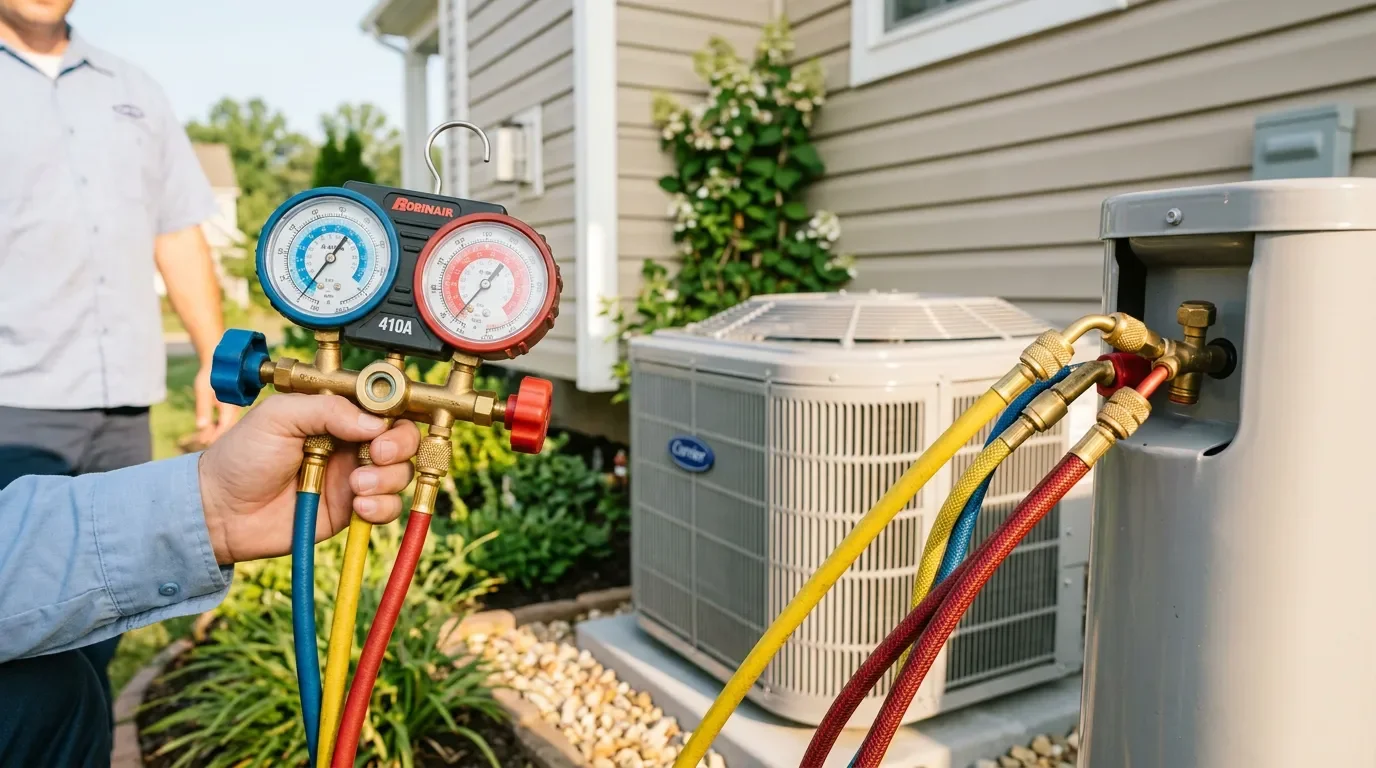
The HVAC industry is going through its biggest chemical change in over a decade. Starting in 2025, new air conditioners and heat pumps manufactured in the United States can no longer be built with R-410A refrigerant. If you are planning to replace an aging system in Fairfax County, here is what the move to R-454B means for your home and your budget.
Why R-410A Is Being Phased Out
R-410A has been the standard residential refrigerant since it replaced R-22 (Freon) in the 2000s. The problem is its global warming potential, or GWP. R-410A has a GWP of roughly 2,088, meaning a pound of it traps about 2,088 times more heat in the atmosphere than a pound of carbon dioxide.
Under the federal AIM Act (the American Innovation and Manufacturing Act), the EPA is requiring the industry to cut the GWP of refrigerants used in new equipment. That regulation is what forced the switch, not a single manufacturer's choice. Every brand we install, including Bryant, made the change on the same timeline.
What Exactly Is R-454B?
R-454B is a blend designed to cool just as effectively as R-410A while carrying a much lower environmental cost. Its GWP is around 466, roughly a 78% reduction. Bryant markets its R-454B systems under the Puron Advance name, and other manufacturers have their own branding for the same refrigerant.
For the homeowner, the cooling performance and efficiency you feel in the house are essentially the same. The difference is under the hood: the refrigerant itself, the safety classification, and the components engineered around it.
R-410A and R-454B Compared
The two refrigerants serve the same comfort purpose, but they are not interchangeable.
| Topic | R-410A | R-454B |
|---|---|---|
| Use in residential systems | Longtime standard after R-22 | New lower-GWP standard for many new systems |
| Global warming potential | About 2,088 | About 466, roughly 78% lower |
| Safety classification | A1, non-flammable | A2L, mildly flammable |
| Equipment compatibility | Designed for R-410A compressors, coils, metering devices, and oils | Requires equipment designed and listed for R-454B |
| Retrofit option | Existing R-410A systems can still be serviced with R-410A | R-410A systems cannot be converted to R-454B |
| Homeowner experience | Standard cooling and heat pump operation | Similar comfort experience when installed correctly |
| Installation focus | Proper charge, airflow, evacuation, and matching | All standard commissioning plus A2L-specific sensors, labels, and procedures |
The A2L Mild Flammability Classification
R-410A is classified A1, meaning non-flammable. R-454B is classified A2L, which means it is mildly flammable. This sounds alarming, but A2L refrigerants are difficult to ignite and require a sustained, concentrated leak plus a strong ignition source to burn at all. They are widely used in Europe and Asia and have a strong safety record.
What changes practically is that new equipment includes refrigerant leak detection sensors and, in some cases, a shutoff response that stops the indoor fan from circulating a concentrated leak. This is why an R-454B system is engineered as a complete, matched set and why proper installation by trained technicians matters more than ever.
What A2L Installation Changes in Practice
A2L refrigerants change the installation details, not the way a homeowner uses the thermostat. The equipment is designed with the refrigerant classification in mind. That can include leak detection sensors, control logic that responds to a detected leak, labeling, charging procedures, and installation instructions that specify how the system should be piped and commissioned.
The technician's job is to treat the system as a matched design. Line-set practices, brazing or connection procedures, evacuation, charge weight, airflow, sensor wiring, and startup checks all matter. A2L refrigerants are mildly flammable under specific conditions, so the safety strategy is to prevent a concentrated leak from being circulated or exposed to an ignition source. The equipment and code requirements are built around that risk.
For the homeowner, the important point is that R-454B is not an add-on to old equipment. It belongs in equipment built for it. A new Bryant R-454B system should be installed, charged, tested, and documented according to the manufacturer's instructions. Done correctly, the change should feel ordinary from the living room and precise at the equipment.
How This Affects AC Replacement Costs
You cannot retrofit an old R-410A system to run R-454B. The two refrigerants operate at different pressures and the components, including the compressor and metering devices, are built specifically for one or the other. Mixing them is unsafe and will damage equipment.
In the short term, new R-454B equipment has carried a modest price increase as manufacturers retooled and added leak-detection hardware. Over time those costs settle. The honest takeaway: if you need a full system replacement, you will be buying R-454B, and the price difference is real but not dramatic.
R-454B and Heat Pumps
The refrigerant transition affects heat pumps as well as air conditioners. A heat pump uses the refrigerant circuit in both seasons, rejecting heat outdoors in summer and absorbing heat outdoors in winter. That means R-454B equipment selection matters for cooling efficiency, heating capacity, defrost behavior, and cold-weather operation.
For homeowners considering electrification or dual fuel, the refrigerant change should be part of the replacement conversation but not the only issue. The heat pump still needs the right capacity, airflow, auxiliary heat setup, controls, and electrical support. A lower-GWP refrigerant is a benefit, but the system has to heat and cool the house correctly.
That is why an R-454B heat pump quote should still include Manual J sizing, duct static pressure review, thermostat planning, permit handling, and startup documentation for future service. The refrigerant is new, but the fundamentals still decide performance.
Can You Still Repair an R-410A System?
Yes. The phase-out applies to manufacturing new equipment, not to servicing what is already installed. We can still repair, recharge, and maintain your existing R-410A air conditioner for years to come. R-410A refrigerant remains available for service work.
The caveat is supply and demand. As production winds down, R-410A prices tend to rise, which makes a major leak repair on an old system less economical compared to replacement. We will always tell you honestly when a repair makes sense versus when the math favors a new system.
Repairing an Existing R-410A System
Repairing an R-410A system can still be the right answer. The phase-down does not mean every existing unit is obsolete. A healthy system with a minor electrical failure, dirty coil, clogged drain, failed fan motor, or thermostat problem should be evaluated like any other repair. If the equipment is within a reasonable service age and the repair restores reliable operation, replacement may not be necessary.
The calculation changes when refrigerant is involved. Refrigerant does not get "used up" in a sealed system. If charge is low, there is a leak. A small accessible leak on a younger system may be worth repairing. A coil leak on a 14-year-old system with other wear may not be. R-410A remains available for service work, but supply, price, and future availability are part of the repair-versus-replace discussion.
We also look at what the old system is delivering. If it cools poorly because duct static pressure is high, replacing only the outdoor unit will not fix the root problem. If it short cycles because it was oversized from day one, a new load calculation matters more than matching the old tonnage. The refrigerant transition is important, but it does not cancel the basics of good HVAC design.
Timing Your Replacement in Northern Virginia
There is no need to panic-replace a healthy system. If your air conditioner is running well, keep maintaining it. If your system is 12 to 15 years old, leaking refrigerant, or facing a costly compressor repair, then planning a replacement now means you move straight to the modern, lower-GWP standard.
The worst time to make this decision is during a July heat wave when your system has already failed. We help homeowners across Fairfax County plan replacements in the shoulder seasons, when scheduling is flexible and you are not making a rushed call.
Homeowner Preparation for an R-454B Installation
A little planning makes replacement day cleaner.
- Clear indoor equipment access: The crew needs room around the furnace, air handler, coil, and drain route.
- Clear outdoor access: The condenser or heat pump location needs working space and airflow.
- Ask about the line set: Reuse or replacement should be explained before installation.
- Confirm permit handling: Commonwealth can pull mechanical and electrical permits for residential work.
- Discuss thermostat changes: New equipment may need different controls or programming.
- Keep paperwork: Save model numbers, warranty registration, permit records, and commissioning notes.
- Plan for downtime: Replacement takes the system offline while old equipment is removed and the new system is installed.
There is no reason to replace a healthy R-410A system only because R-454B exists. There is also no reason to pour major money into an old leaking system without comparing replacement. The right timing depends on age, leak history, repair scope, comfort, efficiency, warranty coverage, and whether you can plan the work outside a July breakdown.
Planning a Replacement During the Transition
A homeowner comparing repair and replacement should gather these details before deciding.
- System age: Air conditioners and heat pumps often last 12 to 15 years with proper maintenance.
- Leak history: A recurring refrigerant leak changes the economics of repairing older equipment.
- Major component condition: Compressor, coil, and blower failures deserve a replacement conversation on aging systems.
- Refrigerant type: Know whether the existing system uses R-410A or an older refrigerant.
- Duct condition: New equipment still needs correct airflow, static pressure, and return capacity.
- Load calculation: Manual J should be part of replacement sizing, especially if comfort was never right.
- Efficiency target: SEER2, EER2, and HSPF2 should be compared against budget and comfort goals.
- Incentives: Qualifying heat pumps may be eligible for federal tax credits up to $2,000, and Dominion Energy has offered rebates for qualifying SEER2 ratings.
- Permit handling: Equipment replacement has to meet Virginia code requirements, including mechanical and electrical permits where required.
- Warranty registration: New Bryant equipment must be registered within ninety days for the ten-year parts warranty.
What Commonwealth Recommends
Choose a contractor who is certified and trained specifically on A2L systems, because the leak-detection components and handling procedures are new to the trade. Insist on a proper Manual J load calculation so the new system is sized correctly rather than oversized out of habit.
We install matched R-454B systems, verify leak-detection operation, and document refrigerant charge by weight at commissioning. Done right, the transition is invisible to you: the same cool, comfortable home with a system built to today's environmental standard.
Why Refrigerant Charge Documentation Matters
R-454B systems should be charged and documented carefully. The correct charge depends on the equipment, line-set length, indoor coil, and manufacturer instructions. Too little refrigerant reduces capacity and can overheat the compressor. Too much refrigerant can raise pressure, reduce efficiency, and create reliability problems. The refrigerant transition did not change that physics; it made careful commissioning even more important.
Charge should not be treated as a rough pressure target. Modern systems often require weighing in the factory charge plus any line-set adjustment, then verifying operation with temperature and pressure readings. Airflow has to be correct before refrigerant readings mean much. A dirty filter, undersized return, or incorrect blower setting can make charge appear wrong when the real issue is air movement.
Documentation helps future service. If the startup record shows charge weight, line-set adjustment, static pressure, temperature split, and sensor verification, the next technician has a baseline. That matters when a system is serviced years later and the question is whether performance changed or whether it was never commissioned correctly.
Questions to Ask About a New R-454B Quote
It should be. R-454B systems are engineered as matched equipment, and efficiency ratings depend on certified combinations. Ask for the model numbers and confirmation that the indoor and outdoor sections are designed to work together.
Yes, leak detection and any required control response should be checked during commissioning. A2L equipment adds safety components that need to be wired, tested, and documented according to manufacturer instructions.
Sometimes, but it has to be evaluated. Size, condition, routing, contamination, manufacturer instructions, and code requirements all matter. Reuse should never be assumed just because the old system used refrigerant lines in the same location.
The basic maintenance goals remain the same: clean coils, correct airflow, proper charge, safe electrical operation, and clear condensate drainage. The difference is that A2L-related components and labels become part of the system that should be respected and checked.
Need a hand? Talk to a NATE-certified technician about your system — call (703) 436-8028 or schedule service online.