
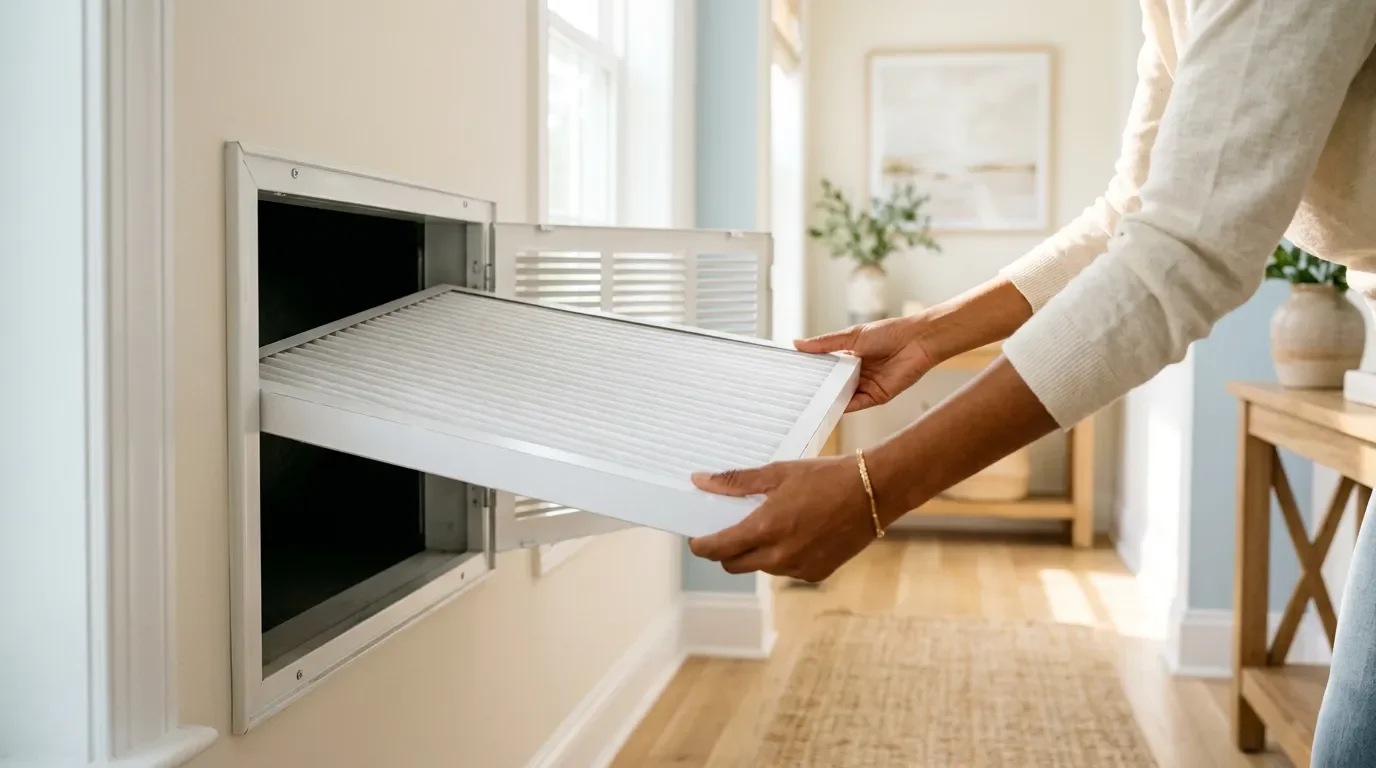
The air filter is the cheapest component in your entire HVAC system, yet choosing the wrong one can quietly raise your energy bills, strain your blower motor, and shorten your equipment's life. Understanding MERV ratings helps you balance clean air against the healthy airflow your system needs to run.
What MERV Actually Measures
MERV stands for Minimum Efficiency Reporting Value. It is the industry-standard scale, running from 1 to 16 for residential filters, that rates how effectively a filter captures airborne particles as air passes through it.
The rating is based on particle size measured in microns. A higher MERV number means the filter traps smaller particles: dust and pollen at the low end, then mold spores and pet dander, and finally fine smoke and bacteria-sized particles at the high end.
The MERV Scale From 1 to 16
MERV 1 to 4 are the cheap fiberglass filters. They protect the equipment from large debris but do little for air quality. MERV 5 to 8 capture pollen, dust mites, and mold spores, and represent the baseline most homes should use. MERV 9 to 12 add fine dust, pet dander, and many auto emissions particles.
MERV 13 to 16 capture bacteria, smoke, and the finest particles, approaching the territory of hospital-grade filtration. For most Northern Virginia homes, the practical sweet spot is MERV 8 to 13, depending on the system and the household's air-quality needs.
Why Higher Isn't Always Better
It is tempting to assume the highest MERV filter is the healthiest choice. In a typical residential system, it is often the opposite. A denser filter restricts airflow, and most home blowers were never designed to pull air through a thick MERV 16 filter.
When airflow drops too far, your air conditioner's coil can freeze, your furnace can overheat and short-cycle, and your energy use climbs as the blower fights the restriction. The goal is the highest filtration your specific system can handle without starving it of air.
Static Pressure and Your Blower Motor
Static pressure is the resistance your blower has to push against, much like blood pressure in your home's ductwork. Every filter adds resistance, and high-MERV filters add a lot. Systems with older PSC (permanent split capacitor) blower motors are especially sensitive, because they cannot ramp up to compensate.
Modern variable-speed ECM motors handle higher-MERV filters better because they adjust to maintain airflow. During a maintenance visit we can actually measure your system's static pressure and tell you the highest MERV rating it will tolerate, rather than guessing.
A good filter cannot help if the rack leaks around it. Dust streaks, loose covers, bent filters, and whistling sounds all point to bypass or restriction. Fixing the rack may improve air quality more than raising the MERV number.
Static Pressure Explains Filter Side Effects
Static pressure is the measurement that keeps filter advice honest. Without it, a filter recommendation is mostly a guess. The technician measures pressure before and after key parts of the air path to see how much resistance the blower is fighting. The filter is only one part of that resistance, but it is the part homeowners change most often.
High pressure creates symptoms around the house
When pressure rises, airflow falls or the blower works harder to maintain it. In cooling mode, reduced airflow can make the evaporator coil too cold and cause ice. In heating mode, reduced airflow can raise furnace temperature rise and trip safety limits. In either mode, rooms farther from the air handler may feel weak because the duct system is already struggling.
This is why the same filter can be fine in one home and a problem in another. A system with large returns, a clean blower, and a deep media cabinet may handle MERV 13 well. A system with a small return, dirty coil, and tight 1 inch rack may struggle with MERV 11. The number on the package cannot see the duct system. A manometer can.
MERV vs. MPR vs. FPR
Walk down a hardware-store aisle and you will see competing rating systems. MPR (Microparticle Performance Rating) is 3M's own scale, and FPR (Filter Performance Rating) is a Home Depot scale. Both exist to differentiate products, and neither matches MERV one-to-one.
As a rough guide, an MPR of 1000 to 1200 or an FPR of 7 lands near MERV 11 to 12. When in doubt, look for the MERV number, which is the only standardized rating defined by ASHRAE and the one HVAC professionals use.
Filters and Indoor Air Quality in Northern Virginia
Northern Virginia has a long, heavy pollen season. Tree pollen in spring, grass through early summer, and ragweed in fall keep allergens high for much of the year. A good MERV 11 to 13 filter, changed on schedule, makes a noticeable difference for allergy-sensitive households.
Filtration only works when air is moving through it, so a filter helps most when your system runs the fan regularly. Many smart thermostats offer a circulation mode that runs the blower periodically even when not heating or cooling, pulling room air through the filter more often.
Household Filter Strategy
Filter choice should match the household and the equipment.
| Household Condition | Practical Starting Point | What to Verify |
|---|---|---|
| No pets, low dust, standard system | MERV 8 to 11 pleated filter | Static pressure and filter fit |
| Seasonal allergies | MERV 11 to 13 if the system can handle it | Return size, blower type, and change schedule |
| Pets in the home | MERV 8 to 13 depending on airflow | More frequent changes and hair buildup at returns |
| Recent renovation | Moderate MERV filter changed often | Construction dust source control and duct cleanliness |
| Smoke or fine particle concerns | Media air cleaner or dedicated IAQ strategy | Blower capacity and whether filtration alone is enough |
| Older PSC blower motor | Conservative MERV choice | Static pressure because PSC motors do not compensate well |
| Modern ECM blower motor | Higher MERV may be possible | Pressure readings, since ECM motors still have limits |
| Tight 1 inch filter rack | Avoid dense filters without testing | Consider deeper media cabinet if filtration goals are higher |
When to Consider a Media Air Cleaner
If you want high filtration without choking your blower, the answer is usually a whole-house media air cleaner. These use a deep 4 to 5 inch pleated cartridge housed in a dedicated cabinet at the furnace. The larger surface area delivers MERV 13 to 16 performance with far less airflow restriction than a thin 1 inch filter.
Media cabinets also need changing far less often, typically every 6 to 12 months. For homes with allergy or respiratory concerns, we also install bypass HEPA and polarized-media options that go beyond standard MERV filtration.
Before Upgrading to a Higher MERV Filter
A few checks can prevent a well-intended filter upgrade from causing airflow trouble.
- Confirm the exact size: Match length, width, and thickness instead of relying on a close fit.
- Check the airflow arrow: Install the filter in the direction of airflow toward the blower.
- Look for bypass gaps: Dust streaks around the filter rack often mean air is going around the media.
- Know the blower type: Older PSC motors respond differently to restriction than modern ECM motors.
- Measure static pressure: This is the cleanest way to know whether the system can handle the filter.
- Inspect the coil and blower: A dirty blower wheel or coil adds resistance before the filter is even considered.
- Avoid stacking filters: Two filters in series can create excessive pressure drop.
- Change on schedule: A moderate filter changed regularly is often better than a high-MERV filter left too long.
- Consider media cabinets: A deeper filter can deliver stronger filtration with less restriction.
How Often to Change Your Filter
A standard 1 inch filter should be checked monthly and changed every one to three months, sooner if you have pets or run the system hard through a Virginia summer. A 4 to 5 inch media filter typically lasts 6 to 12 months.
A clogged filter is the single most common cause of the no-cooling and weak-airflow calls we get. Setting a phone reminder to check your filter on the first of each month is the cheapest maintenance you can do, and it protects everything downstream of it.
Filter Change Timing in Real Use
The calendar is only a starting point. A 1 inch filter in a quiet home may last close to three months. The same filter in a home with pets, renovation dust, heavy pollen exposure, or continuous fan operation may need attention much sooner. A media filter may last 6 to 12 months, but it still deserves inspection because every home loads a filter differently.
The best habit is to check the filter monthly until you know your pattern. Look for dark loading, bending, whistling, dust bypass around the rack, or rooms that feel weaker than usual. If a new filter looks dirty in a few weeks, the house may have a source problem, not only a filter problem. Construction dust, return leaks, pet hair, and gaps around the filter cabinet can all shorten filter life.
MERV FAQ
No. MERV 13 captures smaller particles, but it also may create more pressure drop, especially in a 1 inch filter. If the system cannot move enough air through it, comfort and equipment life can suffer. The best filter is the highest rating your system can handle safely.
A filter that bows or collapses is usually seeing too much pressure difference. It may be too restrictive, clogged, poorly supported, or installed in an undersized return path. The system should be checked before simply replacing it with the same style.
Many washable filters have low particle capture compared with good pleated filters, and they can become restrictive if not cleaned and dried properly. They also vary widely in quality. We usually prefer a correctly sized disposable filter or a properly installed media air cleaner.
Yes, moving more air through a correctly selected filter can improve particle capture over time. The fan setting should be used carefully, though. In cooling season, continuous fan operation can re-evaporate moisture from a wet coil in some systems, increasing indoor humidity.
Filter Problems That Look Like Equipment Failure
A clogged or overly restrictive filter can create service calls that look like major equipment problems. In summer, low airflow across the evaporator coil lowers coil temperature. Moisture freezes on the coil, airflow drops further, and eventually the system may blow warm air because the ice blocks heat transfer. From the thermostat, it looks like the AC failed. At the equipment, the filter may be the first cause.
In winter, low airflow across a gas furnace can raise the heat exchanger temperature. The high-limit switch opens to protect the furnace, burners shut off, and the blower may continue running. Homeowners often describe this as the furnace starting and stopping. The safety is doing its job, but the cause may be a dirty filter, blocked return, dirty blower wheel, or duct restriction.
Filters also affect energy use. A blower working against high pressure draws more power or moves less air, depending on motor type. Rooms become uneven, the thermostat calls longer, and the system loses efficiency. The cheapest component in the system can create expensive symptoms when it is wrong.
Filter Size Is as Important as the Rating
The MERV number gets most of the attention, but the filter size often decides whether that rating works in the real system. A 1 inch filter has limited surface area. When the media gets denser, air has less open path through the filter. That raises pressure drop. If the return duct and filter rack were already small, a higher-MERV 1 inch filter can push the system past the blower's comfort zone.
A deeper 4 or 5 inch media filter has much more surface area. That extra area lets the filter capture smaller particles without creating the same restriction as a thin filter of similar rating. This is why a media air cleaner can be a better answer than forcing a dense filter into a standard rack. The goal is not the thickest filter that fits by force. The goal is the best filtration that keeps airflow inside the equipment's design range.
Fit matters too. If a filter is slightly undersized, air can bypass around the edge and carry dust into the blower and coil. If it is slightly oversized, it may bend, leaving gaps or collapsing under airflow. If the arrow points the wrong direction, the filter media may not seat correctly. Many dust complaints start with a simple fit problem that has been repeated for years.
Need a hand? Talk to a NATE-certified technician about your system — call (703) 436-8028 or schedule service online.